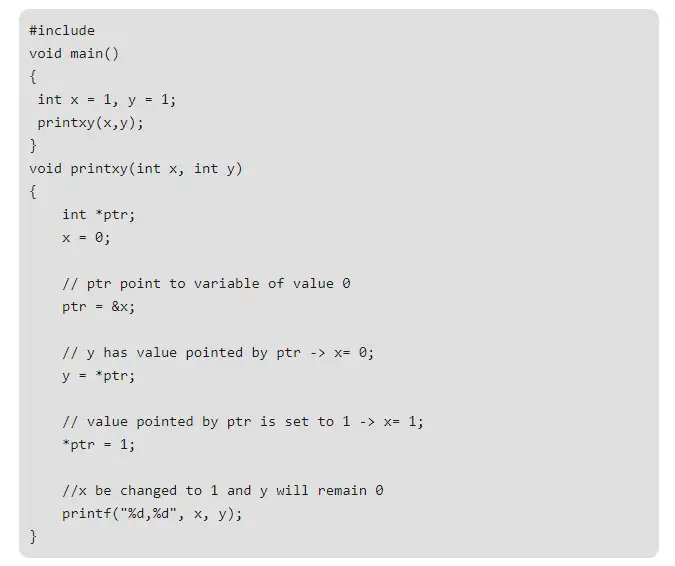
Q. 35 Consider the following function implemented in C:
void printxy(int x, int y)
{
    int *ptr;
    x = 0;
    ptr = &x;
    y = *ptr;
    *ptr = 1;
    printf("%d,%d", x, y);
}
The output of the printxy(1,1) is
(A) 0,0
(B) 0,1
(C) 1,0
(D) 1,1
Answer: (C)
Explanation: